Author: Jd Medlink

How We Added An Individual Provider To A Group; CMS 855R

When a client needed to add an individual provider to an existing group, we turned to CMS Form 855R. Here is a full walkthrough of how we completed that process.

## What Is CMS Form 855R?

CMS Form 855R is the Medicare Enrollment Application used to reassign benefits. When an individual provider wants to reassign their Medicare benefits to a group practice (or be added to one), this is the form you use.

## Step-by-Step: Filling Out the 855R

**Section 1 – Reason for Submission**
Mark “Change of Information” if the provider is already enrolled in Medicare. If this is a new enrollment, mark “Initial Enrollment.”

**Section 2 – Individual Information**
Enter the provider’s personal NPI, name, date of birth, and Social Security Number. Make sure the name matches exactly what is on file with NPPES.

**Section 3 – Reassignment Information**
This is where you enter the group’s billing NPI. You will also need the group’s Medicare PTAN (Provider Transaction Access Number) if available.

**Section 4 – Contact Person**
Include a contact person at the group practice — typically the billing department or office manager.

**Section 5 – Signatures**
Both the individual provider AND an authorized official of the group must sign. This is a common sticking point — make sure both parties are available.

## Mailing the Form

Once complete, mail to the appropriate Medicare Administrative Contractor (MAC) for your jurisdiction.

– **Regular mail:** Expect 14–35 business days for processing
– **Overnight mail:** Expect 7–10 business days

## The Fastest Method: PECOS

If you want the fastest turnaround, skip the paper form and complete the process via PECOS (Provider Enrollment, Chain and Ownership System) at pecos.cms.hhs.gov. Electronic submissions typically process in approximately **1 week**.

## Tips From Our Experience

1. Double-check NPI numbers before submitting — a single digit error means starting over
2. Use PECOS whenever possible for speed
3. Follow up after 10 business days if you have not received a confirmation number
4. Keep a copy of everything you submit for your records

Credentialing delays cost practices real money. If you are adding a new provider and want to make sure the process goes smoothly, reach out to our team at MedLink Services.

Family Practice Physician: Ignore Physician Burnout Statistics By Doing This

A Family Practice Physician must decide between starting a solo practice or becoming a hospital employee.  Here is why starting your own practice may temper Physician Burnout.

You’ve made it through the rigors of Medical School, Residency, and perhaps even a fellowship, and now is the time to decide which family practice physician opportunity is the best for you and your family.  In this post we will be discussing the merits of starting a solo family practice and bucking all negative Physician Burnout Statistics. 

It’s hard to compare being a private practice physician and a hospital owned physician, because in my eyes it wouldn’t even be a comparison.  It really comes down to how you value autonomy and freedom, which I value as being of the utmost importance.  Yes, even over money.

We’ve helped many Family Practice Physicians be successful using our medical billing service, so we know it can be financially successful.  But, there are challenges with Employees, Taxes, Expenses and liability, which can be passed on to the hospital if you are an employee.  So I get it.  As a physician exploring ‘one road or the other’ you have to weigh your options, and determine what is best for you, at this very time.

The Top 5 benefits of a being a Private Family Practice Physician

#1 Enjoying the Freedom and Autonomy to be your own boss.

As I stated this is high on my priority list, while it may not be for others.  But, having the financial autonomy to work when you want to, and with who you want to, is truly hard to even compare.  Being your own boss as a Private Practice Physician comes with financial risk, which you may not have as an employee of a hospital.  That said, being a hospital owned employee, comes with Opportunity Risk, mainly by the fact that you will never know what you could become, if you choose the ‘safe’ route of being a hospital employee.

#2 Choosing which types of patients you want to treat.

Do you want to help the elderly, or perhaps the indigent, or a mix of all.  As a Private Practice Physician, you get to decide; you’re the boss.  Medicare is a great payer, and typically pays in 14-16 days.  Blue Cross is also a great payer, and many people with Blue Cross are employees, with jobs, higher credit scores, and the means to pay their self-pay balance.  You may not want to see Medicaid Patients, which is not as good of a payer as Blue Cross or Medicare.  So, as a Private Practice Physician, you have that complete autonomy to decide who and when to see certain patients.

#3 Family Practice Physicians have the ability to make as much, or little as they want.

Hospital owned physicians are like military GI’s, or otherwise referred to as ‘Government Issue’.  This is a term which means when you join the military, you are indeed property of the government.  Hospital owned physicians are essentially owned by the hospital.  They tell you when you’re on call, when you take vacation, and even how close to the hospital you need to live.  Sounds like they own you, huh?  Seems like you trade your autonomy for a hospital paycheck when you are a hospital owned physician.

#4 Complete autonomy to make the necessary business decisions.

Do you want to implement a 401k for your employees, if so which fund manager do you use.  Do you want to change healthcare coverage because your group deductible keeps going up?  These are the business decisions, you as a Solo Practitioner has the complete autonomy to make.

#5 The thrill of growth and the agony of defeat.

The thrill of growth is understandable, but the agony of defeat?  How is this a benefit?  Well, running a business comes with peaks and valleys, and the agony of defeat helps you maintain humility.  Often times you learn more from defeat.  As a result, you grow and learn, and respect the process more.  This phenomenon shouldn’t be overlooked.

Lastly, Physician Burnout is real!  The pandemic only exacerbated this and in order to sustain a long career in healthcare today, it’s important to resist physician burnout.  One way of doing this while still serving patient needs is by building a business, one which can offer a different area of fulfillment, and one which allows you more autonomy.

Here are some recent Physician Burnout Statistics and the most vulnerable medical specialties at risk.

Physician Burnout Statistics

Statistics provided by Medscape; Death by 1000 cuts; Medscape National physician burnout and suicide report 2021. 

Here are the top 5 things to consider if you plan to start a medical practice.

#1 Choose a location which allows you to keep your expenses low and your exposure high.

According to the Bureau of Labor and Statistics, 17.4% of businesses fail in the first two years, but thats an 83% survival rate.  We can work with that!  And, according to Investopedia’s post; The top 6 reasons new businesses fail  lists #4 as bad location, internet presence and marketing.  Bad location can be a few things; such as not enough exposure, cost of rent is too high, and even something as seemingly mundane as; parking.  If you have to park too far from the office, your disabled or elderly patients may not come.  This ,as you may have guessed, can be the curse of death to any new business.

#2 Pay your Medical Staff well.

The survival of any business comes down to revenue verses expenses, and while this may sound simplistic, it’s often more difficult to manage for the long term.  Paying your Medical Staff well is important, but paying them too well can improve your chance of failure.  You will experience high turnover with receptionists, so finding a family member to work that position in the beginning, is ideal.  Pay the members of your medical staff who are considered; revenue generators, well.  This includes; Nurses, billers, and coders.  Or, outsource this to a boutique billing company such as Medlink Services, who is willing to be paid on a percentage of revenue which is brought into the practice.

#3 EMR vs EHR Software.

The Electronic Health Record Market is confusing, it’s fraught with so many options who offer software programs with slick bells and whistles, which in many cases are un-necessary to the viability of your practice.  Knowing the difference between an (Electronic Medical Record) EMR vs an EHR (Electronic Health Record) can be; ‘make or break” important!

Here are 5 important differences between an EHR and an EMR.
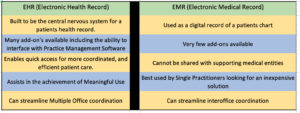
EMR verses EHR


Investing in an expensive EHR Software Program when first starting out as a Family Practice Physician may be a disadvantage.  Many EHR software providers also offer billing as an add-on service.  Often times these are 2 independent software companies; the EHR Software and the Practice Management Software, which are then married together with an interface.  The challenge with these is again, Autonomy, or lack of Autonomy.

If for instance, you like your EHR, but don’t think the company is doing a good job with your claims follow-up, then its more complicated to change the staff who is doing your billing because they are all tied together.

Or, if for instance you have software issues, which take a while to get resolved, and meanwhile your claims are stuck or unable to be billed out, and your money suffers.  This is why Medlink Services is a ‘Software Agnostic’ billing company who welcomes any EHR, or EMR you desire.

#4 Success will depend on vigorous public outreach.

Running any successful business depends on the public’s perception of the business.  This is no different for a Family Practice Physician’s business.  Public outreach creates a connection with the community, which is exceptionally important.  Sponsoring events, sitting on boards, working at the local food bank, are all examples of public outreach that can enable you to gain positive exposure and will eventually lead to more business.  It’s great to do for your business, not to mention, its great to be able to serve the public in a selfless manner.

#5 Never forget you are building a tangible asset.

It’s true, the more ‘sweat equity’ you put into building your Private Physician Practice the more it becomes worth to someone in the future.  You may decide to sell your practice one day and its value will matter.  A Tangible Asset is something of value that you can see, touch, and feel.  And, A private medical practice falls into that category.  There will always be a value to a medical practice, and like most other tangible assets, this value increases over time.

So, if you are a Family Practice Physician evaluating between opening your own clinic or becoming an employee of a hospital, we hope this post helps you understand the value of owning and building a long-term tangible asset.  Owning a business is rewarding, and is truly a lifestyle, rather than a job.

 

Family Practice Physician: Ignore Physician Burnout Statistics By Doing This

Medscape’s annual physician burnout survey consistently shows that employed physicians — especially those working in large hospital systems — report higher rates of burnout than their independent counterparts. If you are a family practice physician feeling the weight of administrative burden and loss of clinical autonomy, there is a path forward.

## The Case for Solo Practice

Starting your own family practice gives you control over the things that matter most to you as a clinician. Here are five benefits worth considering:

### 1. Freedom and Autonomy
You set the schedule. You decide how long appointments run. You choose the patient population you serve. Autonomy over your clinical environment is one of the most powerful antidotes to burnout.

### 2. Patient Selection
In private practice, you can define the type of practice you want to build — concierge, direct primary care, insurance-based, or a hybrid. You can build relationships with patients over years, not minutes.

### 3. Income Control
In an employed model, your income is determined by your employer. In private practice, your income reflects your work, your efficiency, and your business decisions. Many physicians earn more in private practice once they get past the startup phase.

### 4. Business Decisions Are Yours
Technology choices, staffing decisions, office policies — you control all of it. If you want to implement a specific EHR or run a lean two-person office, you can.

### 5. Growth and Learning
Running a practice forces you to develop business skills that make you a more complete professional. The challenge of ownership also keeps work mentally stimulating in a different way than clinical work alone.

## 5 Key Considerations Before You Start

**Location**
Analyze the competitive landscape and patient demographics in your target zip code. A rural underserved area may offer faster ramp-up with less competition. Urban markets may have higher volume potential but more competition.

**Staff Compensation**
Staff costs are typically the largest operating expense after rent. Build a realistic compensation model before you sign a lease. Factor in benefits, payroll taxes, and turnover costs.

**EMR vs. EHR**
These terms are often used interchangeably, but they are not the same. An EMR is a digital version of the paper chart for a single practice. An EHR is designed to share information across multiple care settings. Choose based on how you intend to coordinate care.

**Public Outreach**
Building a patient panel takes time. Develop a referral strategy, maintain an active online presence, and consider community outreach events in your first year.

**Tangible Asset Building**
Owning your practice means you are building an asset that has real value — one you can sell, transition, or pass on. Think long-term about what you are building, not just what you are earning today.

## The Bottom Line

Physician burnout is real, but it is not inevitable. For family practice physicians who want clinical autonomy, income control, and the satisfaction of building something meaningful, private practice is worth the challenge.

MedLink Services works with independent practices of all sizes. If you are starting a new practice and want to get billing right from day one, contact our team.

Billing For Physical Therapy Services: Quick Guide (2022)

Physical therapy billing has its own vocabulary, workflows, and compliance considerations. Whether you are a new PT practice or an experienced clinic looking to tighten up your revenue cycle, this guide covers the fundamentals.

## What Makes PT Services Medically Necessary?

Medicare and most commercial payers require that PT services be medically necessary. Common conditions that support medical necessity include:

– **Ankle ligament surgery** — post-surgical rehabilitation is a standard medically necessary indication
– **Knee replacement** — total or partial knee arthroplasty requires structured PT for functional recovery
– **Hip replacement** — post-replacement PT is typically pre-authorized and expected
– **Shoulder replacement** — rotator cuff repairs and total shoulder arthroplasty require progressive PT protocols

Documentation must clearly support the clinical need for skilled intervention, functional goals, and the expectation of improvement.

## Key PT Billing Terminology

**Initial Evaluation (IE)**
The first visit with a new patient or a new episode of care. Billed with codes 97161, 97162, or 97163 based on complexity (low, moderate, high).

**Plan of Care (POC)**
A written treatment plan that defines the patient’s goals, anticipated frequency and duration of treatment, and interventions to be used.

**Initial POC Certification**
The treating physician or non-physician practitioner must certify the plan of care. Without this, Medicare will not reimburse.

**Documentation**
Every visit must be documented with the time spent on each procedure, the clinical rationale, and the patient’s response to treatment. Timed codes require accurate 8-minute rule tracking.

## The CMS Form 1500

Physical therapy services billed to Medicare and most commercial insurance are submitted on the CMS Form 1500 (or its electronic equivalent, the 837P). Key fields include:

– **Box 21:** Diagnosis codes (ICD-10)
– **Box 24D:** Procedure codes (CPT)
– **Box 24J:** Rendering provider NPI
– **Box 33:** Billing provider information

## Practice Management Software and Clearinghouses

Most PT practices use a combination of:
1. **EMR/EHR** for documentation and scheduling
2. **Practice Management (PM) software** for billing and claims
3. **Clearinghouse** to scrub and transmit claims electronically

Some platforms combine all three. Others separate the EMR from the PM, which gives practices more flexibility to choose best-in-class tools for each function. The clearinghouse performs pre-submission edits that catch common errors before the claim reaches the payer.

## 2022 Medicare Fee Schedule — Common PT Codes

| CPT Code | Description | 2022 Medicare Rate (National) |
|———-|————-|——————————-|
| 97110 | Therapeutic exercise (15 min) | $32.99 |
| 97530 | Therapeutic activities (15 min) | $42.35 |
| 97140 | Manual therapy (15 min) | $35.76 |
| 97012 | Mechanical traction | $23.61 |
| 97162 | PT evaluation, moderate complexity | $108.78 |
| 97116 | Gait training (15 min) | $35.76 |

*Rates vary by geographic location. Always verify with your MAC.*

## Final Thoughts

Physical therapy billing is detail-intensive. A single missing signature or incorrect modifier can delay or deny payment. If your PT practice is struggling with denials or AR over 90 days, our team at MedLink Services can help you identify and resolve the root causes.